Sustainability Policy
With the goal of bringing “Innovation from Japan to the world,” all of us are united in our pursuit of “Creating high value-added services” that contribute to the business success of our clients. We strive to generate a positive impact on society through our business activities and to fulfill our responsibility as an innovation-creating company committed to building a sustainable society.
Sustainability Management Structure
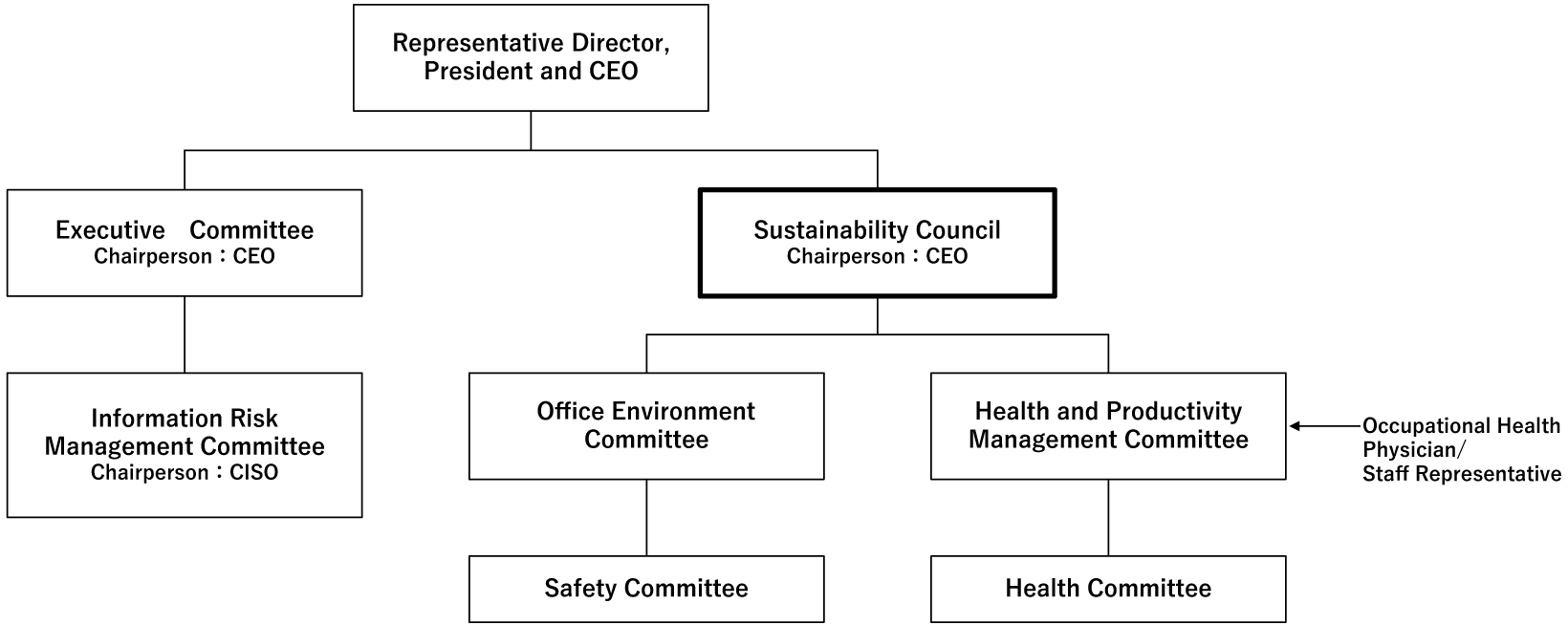
The Simplex Group has established the Sustainability Council to move forward with sustainability initiatives under the authority of the council. The Sustainability Council consists of the Representative Director, President and CEO (the “CEO”) and Executive Directors of the Company and its subsidiaries and is chaired by the CEO.
In addition, to discuss specific issues related to employees’ health and safety and execute business, the Company has built an organizational structure with the Health and Productivity Committee and the Office Environment Committee set up under the Sustainability Council, the Safety Committee under the Office Environment Committee and the mandatory Health Committee under the Health and Productivity Management Committee. The Health and Productivity Management Committee seeks the involvement of occupational health physicians and employee representatives to plan, formulate, and implement measures that contribute to the maintenance and improvement of workers’ and their families’ physical and mental health, and as a result, to the improvement of productivity.
Further, to manage risks associated with cyber security and data security, the Company has appointed Chief Information Security Officer (the “CISO”), and has set up the Information Risk Management Committee as an advisory body to the CISO, which consists of representative members from each business division, including the division heads, to build a structure whereby it collects information across the Company to resolve issues.
Governance Risk Management Structure
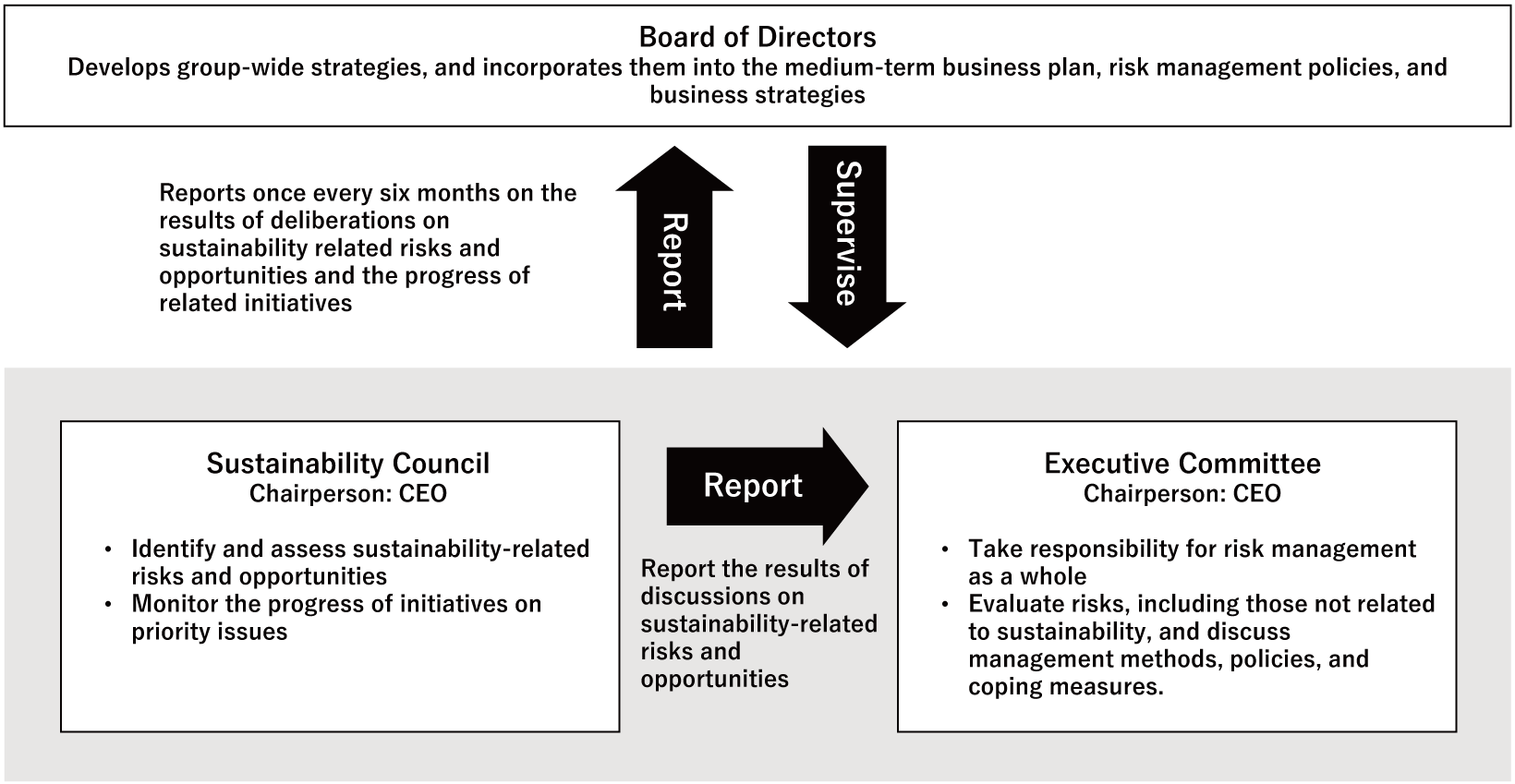
The Simplex Group carries out company-wide risk management at its Executive Committee meetings, which are chaired by the CEO. However, authority is delegated to the Sustainable Council for matters related to sustainability.
Matters discussed at the Sustainability Council meetings are reported to and discussed at the Executive Committee as part of company-wide risk management. They are also reported to the Board of Directors on a semi-annual basis, enabling executive oversight.
Based on these reports, the Board of Directors incorporates the results of discussions into group-wide strategies, etc.
Materiality for the Simplex Group
Process of identifying materiality issues
01
Identification of issues
While operating companies often prefer to develop systems in-house, we recognize that barriers to successful in-house system development at non-tech companies are high, given social conditions such as technological innovation in generative AI and the rapid decline in the working-age population. In order to resolve these issues, we interviewed each department to determine what materiality issues should be selected for the Simplex Group, and extracted all possible issues.
02
Determination of importance
First, the materiality issues are divided into two categories: business materiality issues, which are issues to be addressed in the normal course of business, and management foundation materiality issues, which are issues that are linked to promoting business and strengthening the management foundation. Then, we evaluate based on two aspects: importance to the Simplex Group and importance to stakeholders, including our clients, business partners, shareholders and investors. In assessing these issues, we refer to domestic and international standards such as the Guidance for Collaborative Value Creation and the SASB Standard*1, and select items that are important for both categories, as well as items that are important as social issues even if they are important for only one of them.
03
Discussions at executive committee, sustainability council, etc.
The appropriateness of these evaluations is discussed at Management Committees and the Sustainability Council, and materiality issues determined to be important from a management’s perspective are selected.
04
Discussion and decisions by the board of directors
Ultimately, the Board of Directors, including outside directors who are experts in various fields such as management and law, hold discussions and determines materiality issues for the Simplex Group.
05
Feedback from stakeholders
We undertake timely reviews of materiality issues we highlight, taking into account changes in social conditions and the internal environment, as well as feedback from our clients, business partners, shareholders, investors, and other stakeholders.
Sustainability Accounting Standards Board
Addressing Material Issues
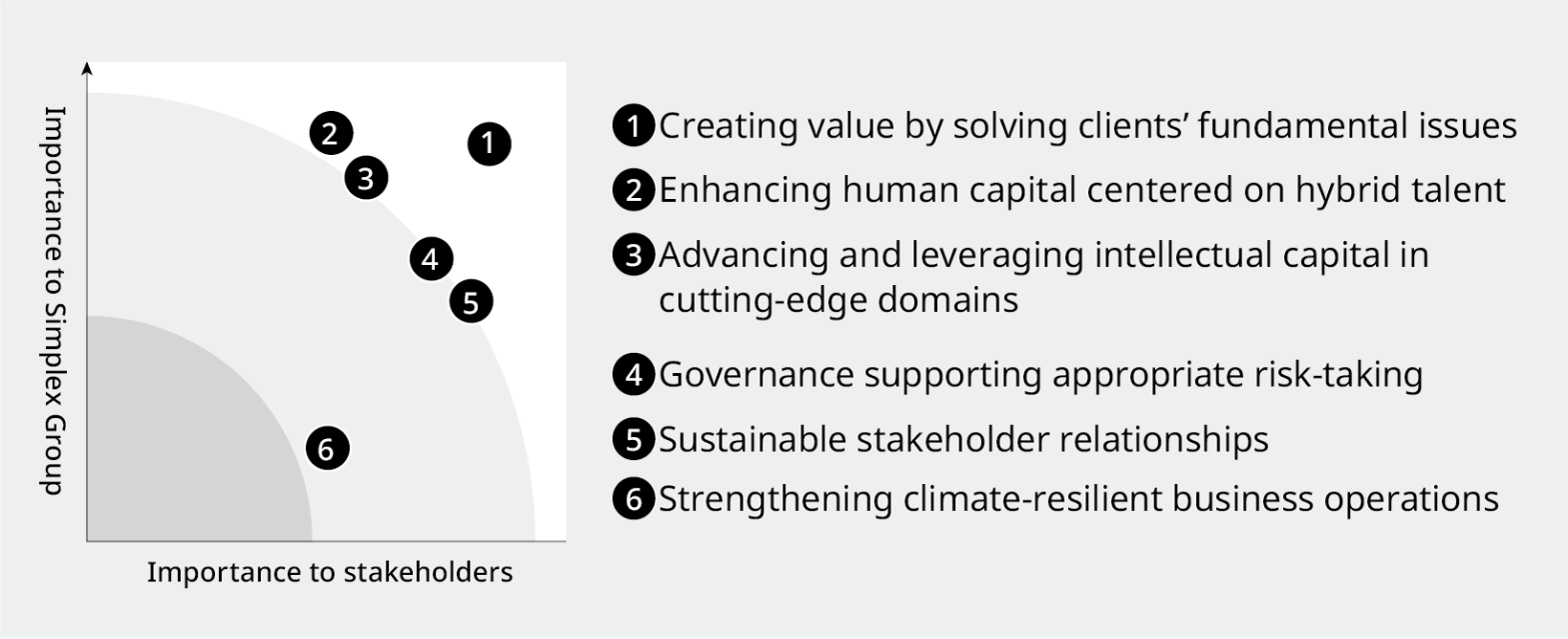
To realize our Medium-Term Business Plan 2030 – Vision 1000, the Simplex Group has reassessed and reorganized its materiality and established six new materiality priorities. Beginning with creating value by addressing our clients' fundamental challenges, we will continue to strengthen the human and intellectual capital that underpins this value creation. At the same time, by reinforcing the foundations that support our business execution, including governance and risk management, we aim to achieve the sustainable enhancement of corporate value.
List of Materiality Issues
| Materiality | |
|---|---|
| Driving Value Creation | 01 Creating value by solving clients’ fundamental issues |
| Strategic Capital for Value Creation | 02 Enhancing human capital centered on hybrid talent |
| 03 Advancing and leveraging intellectual capital in cutting-edge domains | |
| Execution Platform Supporting Value Creation | 04 Governance supporting appropriate risk-taking |
| 05 Sustainable stakeholder relationships | |
| 06 Strengthening climate-resilient business operations |
Driving Value Creation
01 Creating value by solving clients’ fundamental issues
We define a source of corporate value as “addressing clients’ fundamental issues=value creation,” and the realization of this is underpinned by accumulation and enhancement of advanced human capital and intellectual capital, which serve as foundation. What we emphasize is talent who can create new values while viewing change as an opportunity andnot limiting themselves to a specific technological area. We continuously and appropriately develop and allocate such talent through structured training programs, strategy-linked assignment design, and knowledge sharing and utilization platforms, thereby establishing the structure that helps create competitive advantage sustainably.
We provide full cycle coverage support from strategy planning to execution and establishment, which enhances the effectiveness of the concept and the likelihood of generating results. At the same time, by integrating expertise across business and technology, we realize the implementation of transformation and the maximization of results. In addition, by structurally accumulating and utilizing the knowledge and experience of diverse specialized talent, we increase the speed and reproductivity of value delivery through the reuse and cross-organizational application.
Furthermore, through our initiatives built on human and intellectual capital, we expand into diverse sectors, including government agencies and social infrastructure areas, beyond the financial and non-financial sectors, thereby contributing to enhancement of the competitiveness and sustainable growth of our clients. Additionally, the ripple effect drives industrial and societal transformation. We extend our role into a function that underpins the evolution of economic and social systems.
Major Individual Issues
- Promoting integrated value delivery from strategy to implementation
- Enhancing convenience and sophistication of financial services
- Supporting DX at non-financial corporations, government agencies, and public institutions
- Developing industry and market infrastructure
- Ensuring delivery quality and stable operation
Strategic Capital for Value Creation
02 Enhancing human capital centered on hybrid talent
We will enhance the reproductivity and productivity of value delivery through acquiring, training, and appropriately allocating hybrid talent who can view change as an opportunity and move toward value creation. Along with this, we continue to monitor closely the trends in external expertise and capabilities. Through diverse approaches including M&A, we incorporate talent and functions that align with our strategy in an agile manner. By doing this, we aim to expand our supply capacity and further improve productivity.
Major Individual Issues
- Expanding recruitment infrastructure
- Developing hybrid talent
- Optimizing resource management
- Enhancing retention and engagement
- Implementing appropriate evaluation and compensation system
03 Advancing and leveraging intellectual capital in cutting-edge domains
By accumulating and organizing the knowledge acquired in the cutting-edge area in an organized and structured manner, we aim to enhance the productivity and quality of value delivery through the reuse and cross-organizational application. Positioning R&D as a complement, we support acquisition and capitalization of knowledge and technology.
Furthermore, through proactive information dissemination, we disseminate expertise externally, aiming to enhance recognition and trust and to strengthen recruitment competitiveness.
Major Individual Issues
- Evolving a business model using AI
- Strengthening capabilities that drive competitive advantage
- Promoting R&D
- Expanding and reusing software assets
- Enhancing brand value by disseminating knowledge
Execution Platform Supporting Value Creation
04 Governance supporting appropriate risk-taking
To enable agile decision making and growth investment, we aim to establish governance that supports appropriate risk-taking and to advance risk management system. We will enhance the quality of decision making through the Boad of Directors’ supervisory and control functions in addition to the strategic alignment, financial discipline, and risk assessment.
Furthermore, we aim to ensure business continuity and build trust through continued monitoring based on company-wide risk management.
Major Individual Issues
- Establishing AI governance
- Enhancing information security
- Ensuring corporate governance and effectiveness
- Advancing risk management
- Ensuring compliance
05 Sustainable stakeholder relationships
We focus on continued dialog with stakeholders as the foundation to support value creation and medium- to long-term corporate value enhancement. We accurately understand expectations and demand from shareholders and investors, clients, employees, business partners, and society and build trust through highly transparent information disclosure and communication, which then we aim will be reflected in our management and business operations.
Major Individual Issues
- Building relationships with stakeholders
- Engaging in constructive dialogue with shareholders and investors
- Building stronger relationships with clients
- Strengthening trust with employees
- Strengthening relationships with business partners
06 Strengthening climate-resilient business operations
By factoring climate change risks and opportunities to management decisions and reflecting them in our business operations and value chain, we aim to ensure business continuity and strengthen resilience.
We also increase the transparency of disclosure by aligning with global frameworks, aiming to enhance credibility with the capital markets.
Major Individual Issues
- Responding to TCFD Recommendations
- Ensuring business continuity
- Responding to regulatory and market changes
- Advancing value chain alignment
Related Links
Metrics related to our materiality issues can be found in the Sustainability Data.
https://www.simplex.holdings/en/sustainability/data/
Materiality Map
In creating the materiality map, the materiality issues are first divided into two categories: business materiality issues, which are issues to be addressed in the normal course of business, and management foundation materiality issues, which are issues that are linked to promoting business and strengthening the management foundation. Then, we evaluate based on two aspects: importance to the Simplex Group and importance to stakeholders, including our clients, business partners, shareholders and investors.